
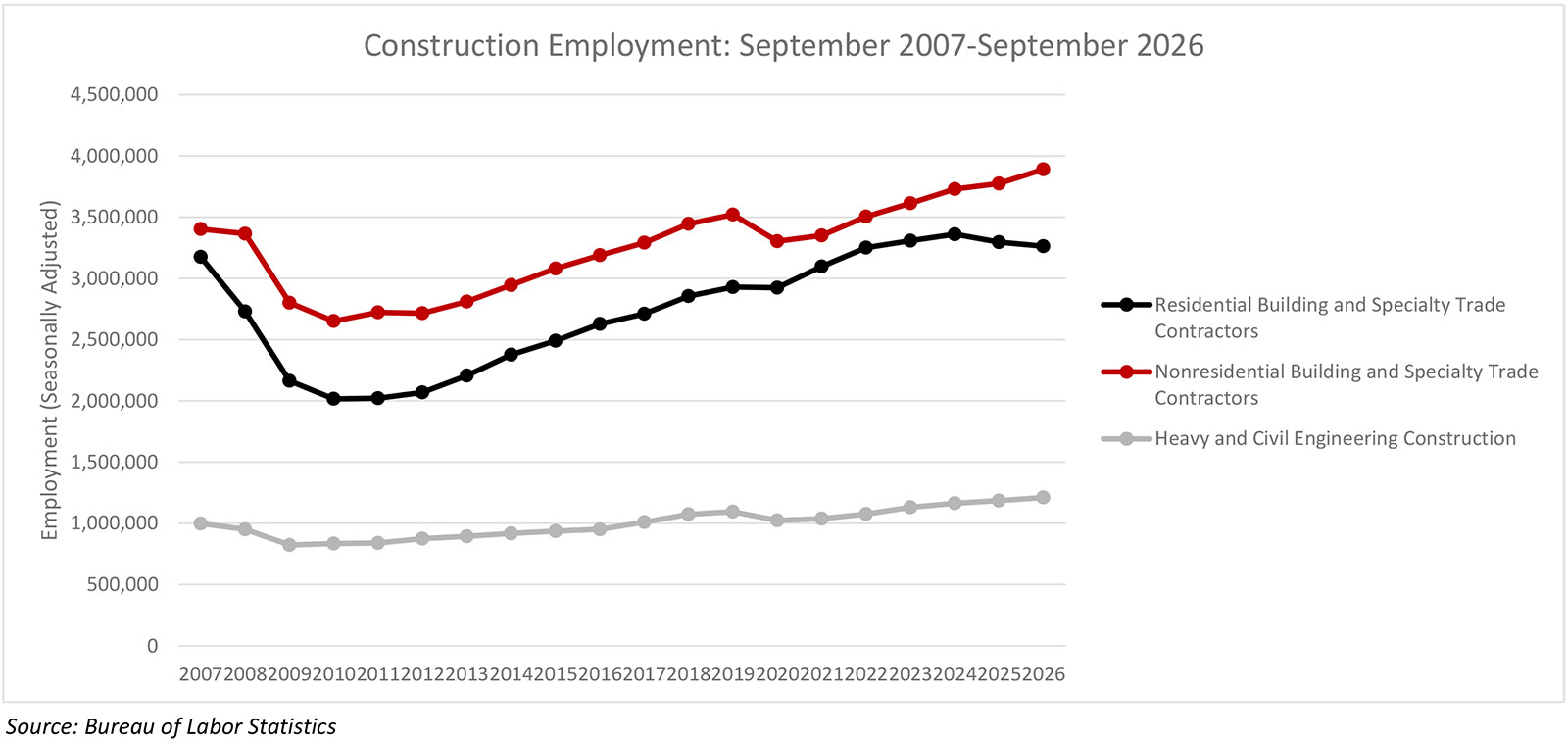
According to data released today by the US Bureau of Labor Statistics:
- The construction industry added 11,000 jobs on net in September. On a year-over-year basis, industry employment grew by 109,000 jobs, an increase of 1.3%.
- Nonresidential construction employment increased by 16,100 positions on net, with gains in all 3 subcategories.
- "Industry employment growth is increasingly concentrated on the nonresidential side as the data center boom continues to support rapid hiring of certain specialty trade contractors."
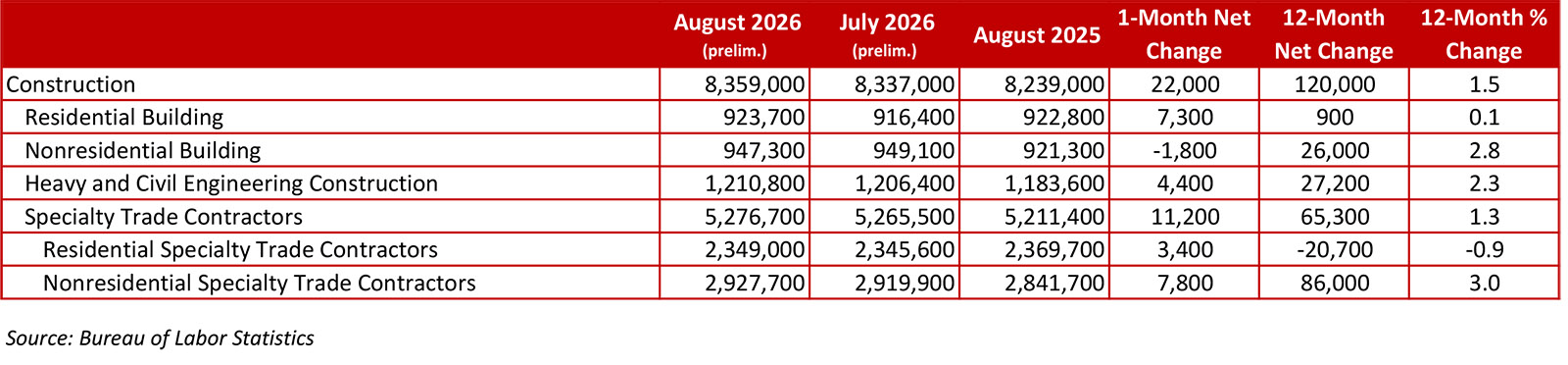
Press Release from Associated Builders and Contractors, Inc (ABC)
ABC: Data Centers Power Construction Job Growth in September
WASHINGTON, Oct. 2—The construction industry added 11,000 jobs on net in September, according to an Associated Builders and Contractors analysis of data released today by the U.S. Bureau of Labor Statistics. On a year-over-year basis, industry employment has increased by 109,000 jobs, or 1.3%.
Nonresidential construction employment increased by 16,100 positions in September, with gains in all three subcategories. Nonresidential specialty trade added the most jobs, growing by 12,300 positions, while heavy and civil engineering and nonresidential building added 2,600 and 1,200 jobs, respectively.
The construction unemployment rate was 3.5% last month. Unemployment across all industries increased to 4.2% but is 0.2 percentage points lower than one year ago.
“The construction industry added jobs for the seventh straight month in September,” said ABC Chief Economist Anirban Basu. “Industry employment growth is increasingly concentrated on the nonresidential side as the data center boom continues to support rapid hiring of certain specialty trade contractors.
“At the same time, the residential segment continues to hemorrhage workers, and that side of the industry has now shed 1.0% of its employment base over the past year,” said Basu. “Contractor hiring expectations remain elevated, according to ABC’s Construction Confidence Index, an outlook that seems justified given the insatiable demand for new data centers.”
Press Release from Associated General Contractors of America (AGC)
Industry Employment Rises by 1.3% and Hourly Wages Climb by 4.3%, Outpacing Overall Labor Market; Sharp Decline in Number of Jobseekers with Construction Experience Underscores Difficulty in Adding to Job Gains
Construction firms added 11,000 jobs in September and the industry’s unemployment rate fell to 3.5% according to an analysis by the Associated General Contractors of America of new government data released today. Association officials said the gains underscore the need to both address persistent workforce shortages and sustain demand for construction by passing a new long-term highway and transportation bill and allowing responsible data center and other major projects to move forward.
“Nonresidential contractors are adding employees and raising hourly pay at rates far exceeding the broader economy,” said Ken Simonson, the association’s chief economist. “But filling positions remains a major concern as the pool of jobseekers with recent construction experience continues to shrink.”
Construction employment totaled 8,364,000 in September, an increase of 11,000 from August. The industry added 109,000 jobs over the past year, a gain of 1.3%, outpacing the 0.3% increase in total nonfarm payroll employment.
Nonresidential construction firms accounted for all of the industry’s job gains, as they added 16,100 employees for the month and 142,000 or 2.9% over the past year. Employment at residential builders and subcontractors combined declined by 4,900 workers in September and 32,800 (-1.0%) over 12 months.
Gains were widespread among nonresidential firms. Nonresidential building firms added 1,200 positions in September and 31,000 (3.4%) over the past year. Nonresidential specialty trade contractors added 12,300 employees for the month and 84,700 (3.0%) over the year. Heavy and civil engineering construction employment increased by 2,600 positions in September and 26,300 (2.2%) over 12 months.
Average hourly earnings for production and nonsupervisory employees in construction, which covers most onsite craft workers as well as many office staff, increased to $39.20 per hour in September. That figure is 20.2% higher than the $32.60 average for all private-sector production employees. Construction pay rose 4.3% over the past year, compared with a 3.3% gain for production workers in the overall private sector.
The number of people actively looking for work who had recent construction experience shrank to 359,000 last month, a decline of 45,000, or 11%, from September 2025. The unemployment rate among these jobseekers fell to 3.5%, not seasonally adjusted, from 3.8% a year earlier. The persistently low unemployment rate among experienced construction workers underscores the difficulty many contractors face in filling open positions.
Association officials said the industry’s outlook depends not only on finding enough workers, but also on maintaining a strong pipeline of projects. They urged lawmakers to pair workforce investments with policies that sustain construction demand, including passage of a new long-term highway and transportation bill and a permitting environment that allows responsible data center projects and other major investments to move forward.
“Construction firms need both people to do the work and projects to keep those people employed,” said Jeffrey D. Shoaf, the chief executive officer of the Associated General Contractors of America. “That means expanding training opportunities, pursuing sensible immigration reforms, investing in the nation’s infrastructure, and avoiding unnecessary barriers to responsible data center development and other job-creating projects.”