Key Takeaways
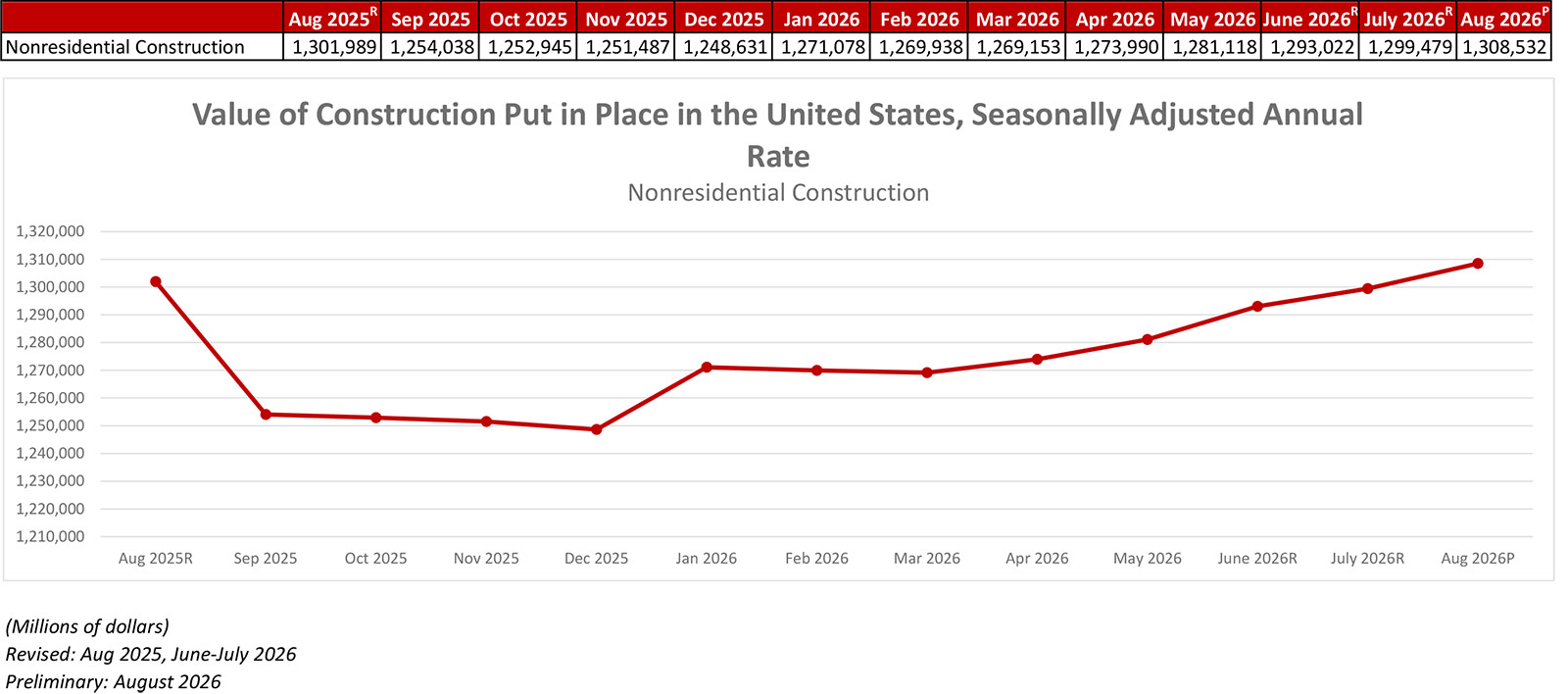
- National nonresidential construction spending increased 0.7% in August.
- On a seasonally adjusted annualized basis, nonresidential spending totaled $1.309 trillion for the month.
- "Despite this broad improvement, momentum will likely remain confined to the data center and power categories in the months to come."
Press Release from Associated Builders and Contractors (ABC)
ABC: Data Center Construction Spending Growing at 149% Annualized Pace Since March
WASHINGTON, Oct. 1—National nonresidential construction spending increased 0.7% in August, according to an Associated Builders and Contractors analysis of data published today by the U.S. Census Bureau. On a seasonally adjusted annualized basis, nonresidential spending totaled $1.309 trillion.
Spending was up on a monthly basis in 11 of the 16 nonresidential subcategories. Private nonresidential spending was up 1.0%, while public nonresidential construction spending was up 0.2% in August.
“Nonresidential construction spending increased for the fifth consecutive month in August as data center investment accelerates,” said ABC Chief Economist Anirban Basu. “Frankly, it’s becoming difficult to contextualize the size and speed of this boom. Data center construction spending leapt another 7.5% in August and is now up more than 73% over the past 12 months. The increases have been particularly large over the past four months, with data center spending increasing at an incredible 149% annualized pace since March.
“While momentum remains particularly concentrated in the data center segment, several other segments posted surprisingly strong spending growth in August,” said Basu. “Manufacturing construction activity, for instance, expanded on a monthly basis for the first time since January, while several public categories grew at a steady, albeit unspectacular, pace.
“Despite this broad improvement, momentum will likely remain confined to the data center and power categories in the months to come,” said Basu. “Materials and labor cost escalation have reemerged during the second half of 2026, and the recent surge in Treasury yields will continue to put upward pressure on borrowing costs. ABC members remain optimistic about the sales outlook, according to ABC’s Construction Confidence Index, yet those sales will increasingly be in a narrow subset of construction categories.”
Press Release from Associated General Contractors of America (AGC)
Latest Data Show Several Major Segments Stabilized or Increased in August; Association Notes Risks from Limited Labor Availability, Rising Materials and Interest Costs, and Delays in Federal Highway Funding
Construction spending increased by 0.9% from July to August but remained 1.7% below the August 2025 level, according to an analysis by the Associated General Contractors of America of a new government report released today. Association officials cautioned that the recent improvement in spending is at risk of stalling or reversing, particularly if Congress fails to act on a long-term highway funding bill as soon as possible.
“It is encouraging to see several construction segments stabilized or turned positive in August," said Ken Simonson, the association’s chief economist. “However, all of these categories remain at risk of stagnating or shrinking as workforce shortages continue to grow, materials costs and interest rates continue to increase, and gridlock in Congress continues to undermine federal funding for highway and transit programs.”
Construction spending totaled $2.20 trillion at a seasonally adjusted annual rate in August. That figure is 0.9% higher than the upwardly revised July rate and 1.7% below the August 2025 level.
Private nonresidential construction increased 1.0% in August but fell 1.0% compared to August 2025. The largest segment, manufacturing construction, was unchanged following a long string of declines, but remained 20% below the year-ago total. The next-largest category, power (including oil- and gas-related projects) rose 0.9% for the month and nearly 10% over 12 months. Private “office” construction, which includes data centers in the government release, jumped 4.6% from July and 30% year-over-year. But this apparent increase was due entirely to data-center construction, which soared 7.5% for the month and 73% over the past 12 months, while other private office construction was unchanged from July and down 9.4% from a year earlier.
Private residential construction rose 1.1% for the month but was 4.8% below the August 2025 level. Single-family construction edged up by 0.2% from July but was down 3.5% year-over-year. Multifamily construction also rose 0.2% for the month but remained 0.6% lower than one year earlier.
Public construction spending increased 0.2% from July and 2.5% year-over-year. The largest public category, highway and street construction, inched up 0.1% from July and was 4.4% higher than in August 2025. Public educational spending also rose 0.1% in August and increased 1.3% over 12 months. Public outlays for transportation facilities such as airports slipped 0.1% for the month but rose 4.4% from a year earlier. Spending on sewage and waste disposal structures climbed 0.2% from July and 1.3% year-over-year.
Association officials warned that the short-term federal highway funding extension that started today does not include funding for a couple of key programs, such as the Bridge Formula Program, which will lead to a decrease in federal infrastructure funding. They urged Congress to pass a new long-term bill promptly after Election Day.
“Congress is leaving until November without providing adequate funding for needed highway improvements,” said Jeffrey D. Shoaf, the association’s chief executive officer. “The current short-term extension leaves some programs short of money. Congress needs to make long-term legislation that includes sufficient funding a top priority when they return.”