
Key Takeaways
- National nonresidential construction spending decreased 0.6% in December
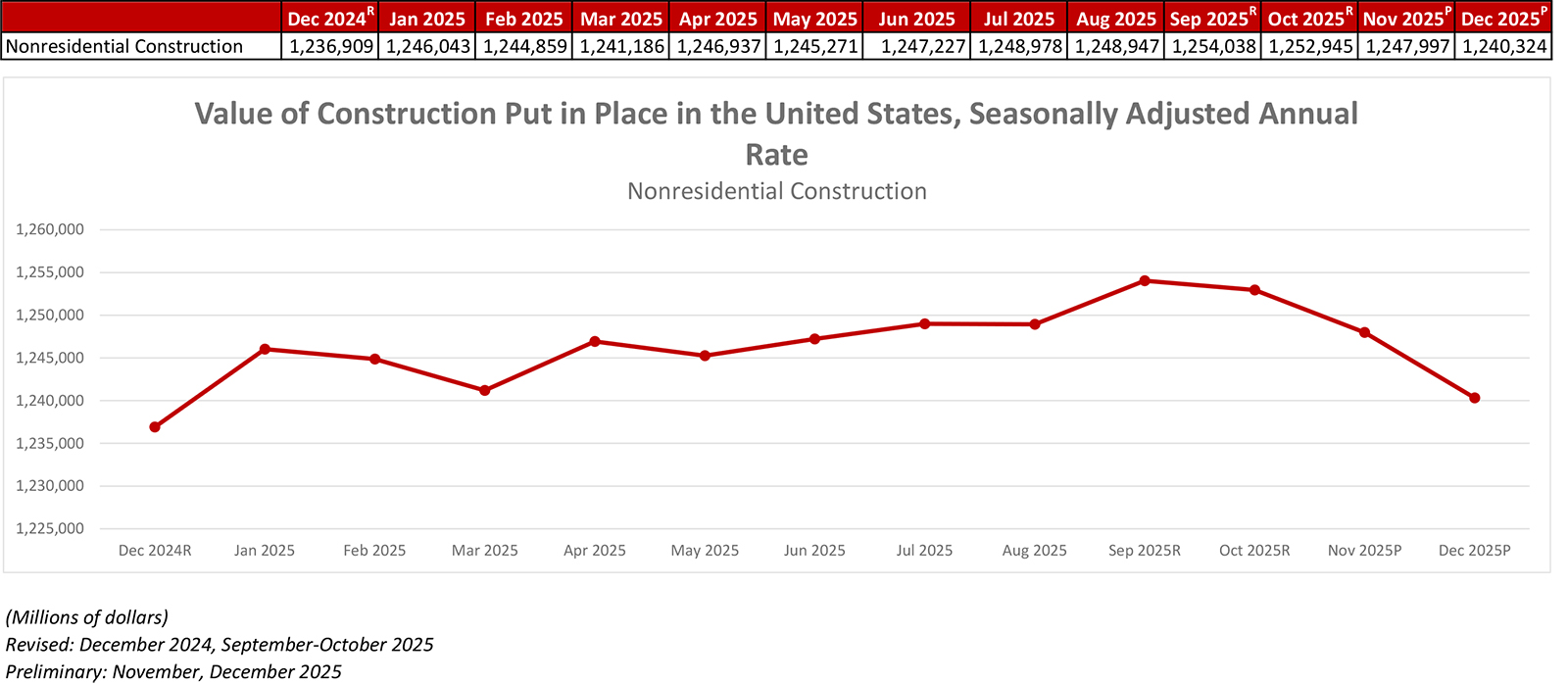
- On a seasonally adjusted annualized basis, nonresidential spending totaled $1.24 trillion for the month.
- "This decline was concentrated in the manufacturing segment, which is now down nearly 16% from the August 2024 all-time high. Given trade policy uncertainty and the waning effects of the CHIPS Act, manufacturing-related spending will likely continue to decline over the next several quarters."
Press Release from Associated Builders and Contractors (ABC)
Nonresidential Construction Spending Plunges in December, Says ABC
WASHINGTON, Feb. 27—National nonresidential construction spending decreased 0.6% in December, according to an Associated Builders and Contractors analysis of data published today by the U.S. Census Bureau. On a seasonally adjusted annualized basis, nonresidential spending totaled $1.24 trillion.
Spending was down on a monthly basis in 12 of the 16 nonresidential subcategories. Private nonresidential spending was down 0.7%, while public nonresidential construction spending was down 0.4% in December.
“Nonresidential construction spending contracted sharply in December,” said ABC Chief Economist Anirban Basu. “This decline was concentrated in the manufacturing segment, which is now down nearly 16% from the August 2024 all-time high. Given trade policy uncertainty and the waning effects of the CHIPS Act, manufacturing-related spending will likely continue to decline over the next several quarters.
“While manufacturing is the most significant driver of nonresidential weakness, it’s far from the only one,” said Basu. “Eight of the 11 private nonresidential subsegments contracted in December, and total private nonresidential spending is now down 1.8% year over year. Given this weakness, it is unsurprising that ABC’s Construction Backlog Indicator fell to a four-year low in January.”
Press Release from Associated General Contractors of America (AGC)
Construction Association Officials Say the Lack of Domestic Supply and Tariffs are Driving up the Cost of Key Materials, Say Best Way to Boost Domestic Production is to Provide Greater Certainty about Demand
The producer price index for materials and services used in nonresidential construction rose 2.9 percent from January 2025 to last month, while construction spending slipped 0.4 percent from December 2024 to December 2025, according to an analysis by the Associated General Contractors of America of two government reports issued today. Association officials said that tariffs are inflating the cost of key materials and urged federal officials to quickly renew key infrastructure measures like the surface transportation bill to give domestic suppliers the certainty they need to boost production.
“Although producer indexes are based on selling prices of domestic producers, the steep tariffs on imported metals and products are clearly enabling U.S. sellers to push up costs for construction materials and equipment,” said Ken Simonson, the association’s chief economist. “Providing domestic producers with greater certainty about future demand should encourage greater production and, ultimately, lower prices.”
The producer price indexes for aluminum mill shapes and steel mill products rocketed up by 33.0 percent and 20.7 percent, respectively from January 2025 to last month, the largest year-over-year increases since the supply-chain disruptions of early 2022. Simonson noted that both indexes have been accelerating every month since the president imposed a 50 percent tariff last June. The index for copper and brass mill shapes climbed 15.7 percent year-over-year in January. Imported products containing copper are also subject to a 50 percent tariff, Simonson noted.
A separate government report showed mixed patterns for construction spending in 2025. The total slipped 0.4 percent from December 2024 to last December. Public construction increased 3.4 percent although the largest segment, highway and street construction, rose only 0.8 percent. Private nonresidential spending declined 1.8 percent, dragged down by an 11.4 percent plunge in the largest subcategory, manufacturing construction. Private residential spending fell 1.3 percent, with a 3.6 percent decline in single-family construction offsetting a 2.9 percent increase in multifamily spending.
Association officials noted that it will be hard for domestic producers to raise capacity for certain key products unless they have more certainty about future demand. That is one reason why the association recently launched a new national campaign, called America’s Moving Forward, to urge Congress to pass a new surface transportation bill before the current legislation expires at the end of September.
“It will be hard for suppliers to boost production if they have no idea about future demand for their products,” said Jeffrey D. Shoaf, the chief executive officer of the Associated General Contractors of America. “Passing the surface transportation bill – the single largest federal construction measure – on time will give domestic suppliers the certainty they need to boost production and offset the impacts of tariffs.”