
Key Takeaways
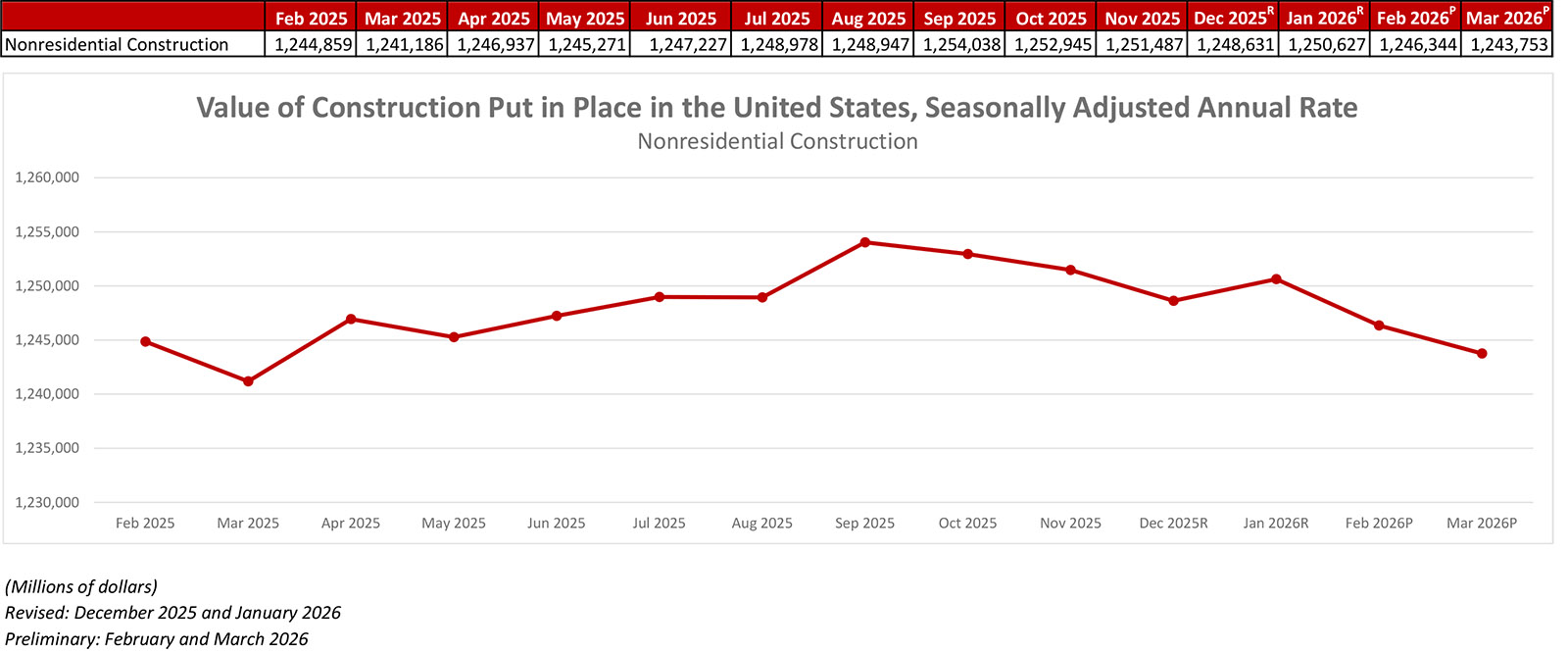
- National nonresidential construction spending decreased 0.2% in March
- On a seasonally adjusted annualized basis, nonresidential spending totaled $1.244 trillion for the month.
- "...investment tied to data centers and power projects continues to support activity, but several traditional nonresidential segments, including manufacturing and commercial construction, continue to lag."
Press Release from Associated Builders and Contractors (ABC)
ABC: Nonresidential Construction Spending Down Again in March
WASHINGTON, May 7—National nonresidential construction spending decreased 0.2% in March, according to an Associated Builders and Contractors analysis of data published today by the U.S. Census Bureau. On a seasonally adjusted annualized basis, nonresidential spending totaled $1.244 trillion.
Spending was down on a monthly basis in 9 of the 16 nonresidential subcategories. Both public and private nonresidential spending were down 0.2% in March.
“Nonresidential construction spending contracted yet again in March,” said ABC Chief Economist Anirban Basu. “While a large portion of the ongoing decline is due to steadily falling manufacturing-related construction activity, weakness is becoming more widespread. Both public and private sector activity fell in March, and the latter is now down more than 2% on a year-over-year basis. With the exception of the ongoing boom in data center construction (+34.3% year over year), there are few sources of momentum. Despite this ongoing weakness, however, contractors remain optimistic about the outlook, according to ABC’s Construction Confidence Index.”
Press Release from Associated General Contractors of America (AGC)
Demand for Construction Remains Concentrated in Data Centers, Power, and Select Residential Segments As Economic Uncertainty Weighs on Private-Sector Demand While Public Spending Remains Steady
Construction spending increased 0.6 percent from February to March as gains in residential construction and continued strength in select private nonresidential segments offset ongoing weakness in manufacturing activity and a slight decline in public construction, according to an analysis by the Associated General Contractors of America of a new government report released today. Association officials noted that ongoing economic uncertainty and rising costs continue to weigh on many private construction segments.
The February and March spending data show that construction growth remains concentrated in a narrow set of categories,” said Macrina Wilkins, Director of Market Insights for the Associated General Contractors of America. “Residential construction rebounded in March and investment tied to data centers and power projects continues to support activity, but several traditional nonresidential segments, including manufacturing and commercial construction, continue to lag.
Construction spending totaled $2.186 trillion at a seasonally adjusted annual rate in March. That figure is 0.6 percent above the revised February rate and 1.6 percent higher than the March 2025 level. Private construction spending increased 0.8 percent for the month and 1.0 percent year-over-year. Private residential construction climbed 3.6 percent compared to a year earlier, including a 2.7 percent monthly increase in single-family construction, although single-family spending remains 4.2 percent below year-ago levels. Multifamily construction edged up 0.5 percent year-over-year.
Private nonresidential construction slipped 0.2 percent for the month and 2.1 percent compared to March 2025. Manufacturing construction continued to weaken sharply, falling 17.0 percent year-over-year. By contrast, office construction, which includes data center activity, increased 9.1 percent over the past 12 months, while power construction rose 4.6 percent. Several other segments posted modest gains, including amusement and recreation, educational, and commercial construction.
Public construction spending decreased 0.2 percent for the month but remained 3.6 percent above year-ago levels. Highway and street construction increased 3.8 percent compared to March 2025, while transportation construction rose 2.5 percent and sewage and waste disposal construction jumped 9.7 percent year-over-year. Education construction spending inched up by 0.6 percent over the past year.
Association officials noted that much of the recent construction activity continues to be concentrated in a handful of segments, particularly data centers, power, and select residential categories, while manufacturing and several traditional private nonresidential segments remain soft. They added that although the March data reflect construction activity earlier this spring, contractors and project owners are continuing to navigate uncertainty tied to tariffs, elevated financing costs, labor shortages, and recent volatility in energy markets.
“Demand for data centers and related projects is providing a much-needed boost to overall construction activity,” said Jeffrey D. Shoaf, the association’s chief executive officer. “Unfortunately, a growing number of local officials appear intent on undercutting that growth, and the high-paying construction jobs that come with it, by restricting data center projects.”