
Nonresidential Construction Employment Expands in February
According to data released Friday by the US Bureau of Labor Statistics, the national construction industry added 42,000 net new jobs in February.
Key Takeaways
Top 5 Trends for 2020
Summary written by Andy Holtmann and appeared on the Viewpoint blog.
Nonresidential Construction Added 44,000 New Jobs in January
According to data released Friday by the US Bureau of Labor Statistics, the national construction industry added 44,000 net new jobs in January.
Key Takeaways
Nonresidential Construction Employment Up in December
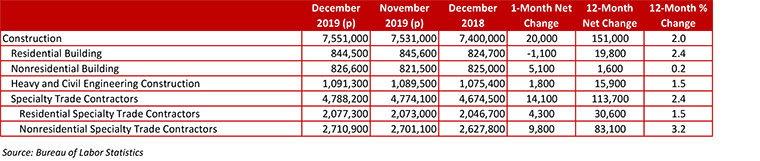
According to data released today by the US Bureau of Labor Statistics, the national construction industry added 20,000 net new jobs in December.
Key Takeaways
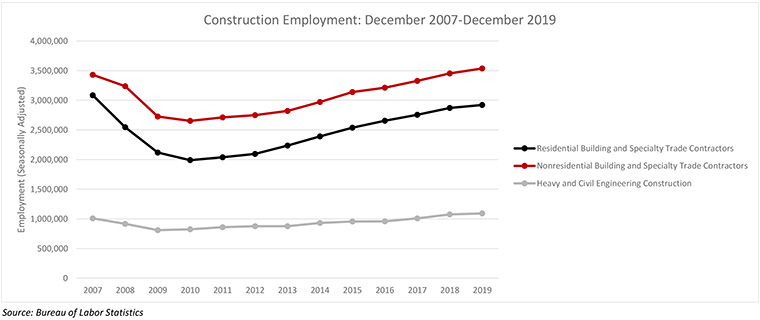
- The construction industry added 20,000 net new jobs in December 2019. On a year-over-year basis, industry employment has expanded by 151,000 jobs, an increase of 2.0%.
- The construction unemployment rate was 5.0% in December, down 0.1 percentage points from the same time last year.
- Nonresidential construction employment increased by 16,700 jobs on net in December and is up by 100,600 net jobs during the last 12 months.
- “Recent data indicate that nonresidential construction spending is no longer expanding rapidly, and this may be due in part to the fact that the industry is approaching its output ceiling due to a shortage of available workers.”
Under Attack: Hackers Find Construction Data Attractive Target
Article written by Steven H. Miller and appears on Constructor Magazine.com.

There is an old adage concerning timely action about the uselessness of locking the stable after the horse is gone. It is, unfortunately, the story of many construction companies confronting the issue of cybersecurity. They never considered themselves a target until it was too late.
Many are surprised by how fast the future has arrived, but it is here now. From payroll and tool-tracking to 3D building models and as-built laser scans, a construction company’s network is the conduit for increasing portions of its activities and is hosting an increasing number of outsiders and their devices. That is an attractive target for thieves, especially since the number of vulnerabilities in the network is growing. If the ‘stable’ in the old adage is your computer network with 250 doors instead of one and strangers going in and out, locking it up is not a simple task. To avoid becoming a victim, cybersecurity must be considered a top issue.
ABC’s 2020 Construction Economic Forecast: Momentum Persists, Despite Uncertainties
Press Release from Associated Builders and Contractors, Inc.
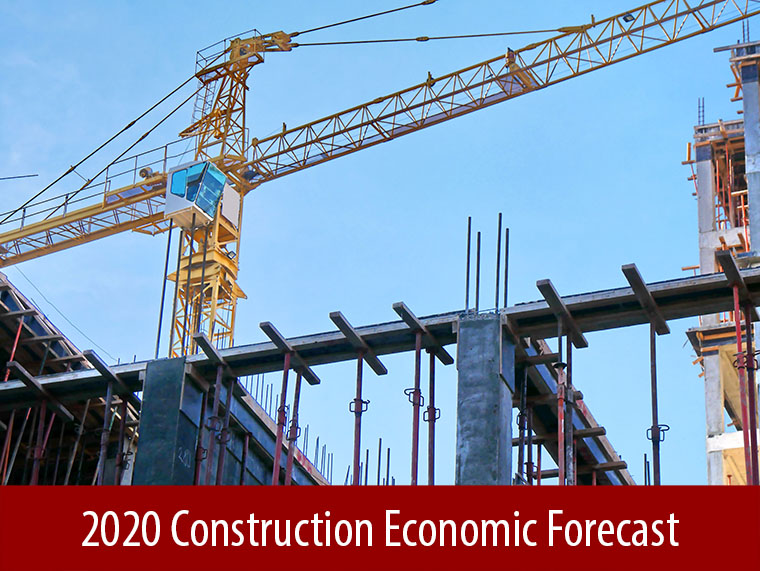 WASHINGTON, Dec. 4—Associated Builders and Contractors Chief Economist Anirban Basu forecasts continued momentum for the construction sector next year but advised an overall “wait-and-see” approach based on leading and lagging indicators and economic uncertainties, according to a 2020 economic outlook published in Construction Executive magazine.
Although ABC’s Construction Backlog Indicator—a leading indicator that reflects projects under contract yet to be executed—climbed to nine months in August 2019, construction spending and employment—lagging indicators—have started to soften. Yet, while spending in private nonresidential categories such as office and logging has decreased, public spending categories remain a bright spot.
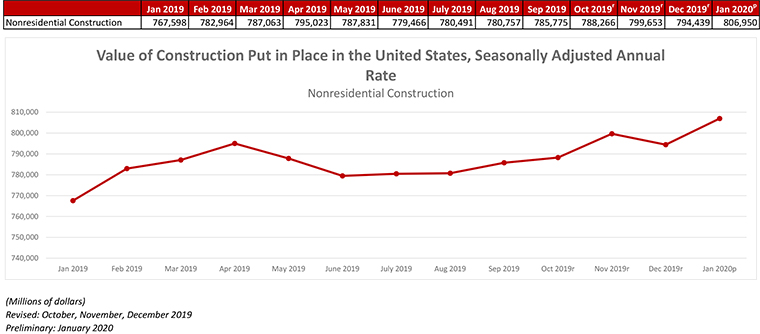
Nonresidential Construction Spending Declines in November
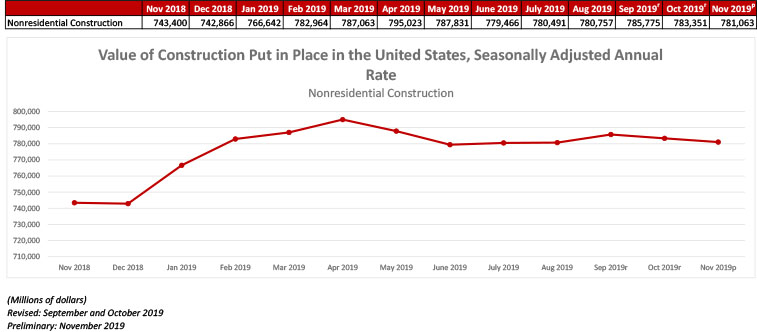
Key Takeaways
- Nonresidential construction spending, which totaled $781.1 billion on a seasonally adjusted annual basis in November, declined .3% from October but increased 5.1% year over year.
- Private nonresidential spending fell 1.2% on a monthly basis and is up by a slight 0.2% compared to the same time last year. Public nonresidential construction spending increased 0.9% in November and is up 12.4% year over year.
- "After sending out recessionary signals during mid-2019, the economy has rebounded despite lingering uncertainty emanating from many sources, including the Middle East. Through it all, the U.S. economy has remained robust, positioning office and other lagging segments to improve during the months ahead.”
Press Release from Associated Builders and Contractors, Inc.
Nonresidential Construction Spending Falls in October

Key Takeaways
- Nonresidential construction spending, which totaled $776.5 billion on a seasonally adjusted annual basis October, fell 0.7% from September but is up 1.4% compared to the same time last year.
- Private nonresidential spending fell 1.2% on a monthly basis and is down 4.3% compared to the same time last year. Public nonresidential construction spending also declined, falling 0.1% from September. On an annual basis, however, public nonresidential spending is up 10.4%.
- "Commercial construction is down more than 16% over the past year, which coincides with the fact that 2019 will set a record for store closings in the U.S. as e-commerce continues to gobble up market share. Lodging and office-related construction has also slowed of late, likely because developers have already exhausted many of the best investment opportunities.”
Press Release from Associated Builders and Contractors, Inc.